
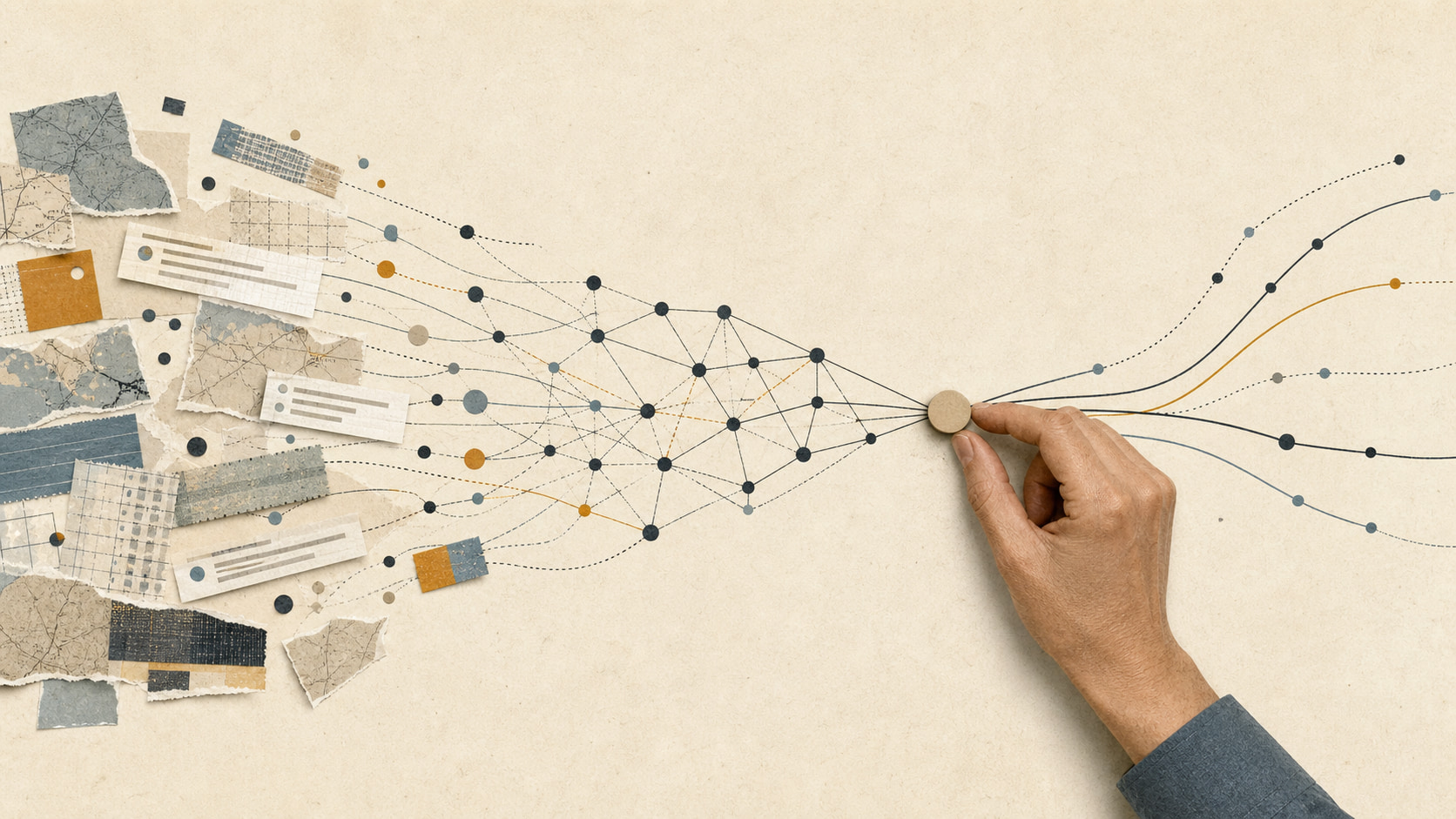
TripShake and the work of interpretation
TripShake, which I cofounded in 2008, started from a simple intuition about how we search. Asking a question and getting an answer is better than breaking what you want to know into ten separate searches, reading twenty pages, and trying to reconstruct the picture on your own.
In travel this was especially clear. Someone planning a trip rarely looks only for a flight or a hotel. They look for a place that fits a season, a budget, the people they are travelling with, and the kind of experience they have in mind. The internet asked them to translate that intention into a sequence of separate operations.
TripShake tried to put those pieces back together through two layers. Travellers brought experiences, local knowledge, and raw material. Travel agents read the question, understood its context, and used that material to reach a useful answer.
Years later the knot seems clearer to me. The semantic tools handled classifying and retrieving information. Interpreting a question, working out what mattered, holding together needs that were still loosely defined: that stayed human work. Today we hand exactly that part to LLMs.
Reading the web through scarcity
That look back led me to read the history of the web through the movement of scarcity. Value tends to concentrate wherever something is hard to produce, and what is hard changes along with the technology.
On the early web, publishing was hard. It took technical skill, infrastructure, and access to tools that few people had. Web 2.0 turned publishing into a mass activity. Millions of people began sharing experiences, opinions, and knowledge.
That abundance created the need for a filter. Search engines, feeds, and recommendation systems began deciding what to show and in what order. They did it through links, behaviour, popularity, similarity, and probability. They could sort an enormous quantity of information, while reconstructing the meaning stayed largely with whoever was searching.
LLMs act on that step. We can phrase a question the way it comes to us, add detail, correct ourselves as we think, and ask the model to work through a large amount of material. The answers can be wrong and they call for judgement, but the machine handles a part of the understanding that in TripShake’s day required a person.
The cost of understanding
Understanding is becoming ambient. In the TripShake model, every new question took time and attention from someone who knew the domain, and the system’s capacity grew along with the number of people able to do that work. Today the same operation can be asked of a model in seconds, repeated, and applied to far larger amounts of material. Accuracy and verification remain open problems, but the cost of a first interpretation has changed.
When a resource stops being scarce, value moves elsewhere.
What the machine does not yet know
The most immediate answer points to what the machine does not yet know: our experience, our data, the information held inside a company. It is useful material, because it lets the model work inside a specific context. A system that knows a firm’s customers, processes, and history produces different answers from one working only on general information.
But it looks to me like a moving frontier. What sits beyond the machine’s reach today can become accessible through a new integration, a change in permissions, or a later version. Much of the information that until recently stayed locked inside documents, email, and business software can already be queried by a model.
The same holds for proprietary knowledge built up over time. It can be a real advantage, but it remains stored information. If it can be archived and structured, it can also be made readable to a system.
Data keeps an important role: it describes what happened, makes patterns visible, and improves the quality of forecasts. The choice of what the company should try to achieve belongs to another level.
The scarce resource is authority over direction
At least as things stand now, the scarce resource is the authority to set the direction the system works toward. The machine can develop an idea, connect it to other information, spot inconsistencies, and suggest alternatives. It can show that a plan is not working, or that a given metric no longer leads to the intended result. But the criterion by which we decide what counts as a good result still comes from outside.
That criterion is not defined once. The context shifts while the system runs. A direction that made sense at the start can become irrelevant, or produce consequences that force a rethink. Part of the responsibility lies in recognising that moment and deciding what has to change.
When the metric is right and the direction is wrong
Picture a small company using a system to decide which sales opportunities to pursue first. The goal is to raise the conversion rate and shorten the time it takes to close a deal. The system quickly learns that customers resembling the ones already won, with standard requests and short decision cycles, are more likely to sign.
Sales attention shifts steadily toward those opportunities. After a few months the conversion rate improves, forecasts become more reliable, and the sales team looks more efficient. At the same time, less room is left for new customers, for more complex projects, and for the relationships through which the company might have evolved.
The system did not make a mistake. It correctly selected what the metric asked it to favour. The question is whether the company should keep getting better at selling what it already sells, or invest in the work it wants to do tomorrow.
The system can help estimate the costs, probabilities, and consequences of both paths. It can also flag that the mix of the portfolio is becoming more uniform. It cannot decide on its own how desirable that uniformity is, because the figure takes on meaning only in relation to the company you want to build.
Contributing is not the same as deciding
The decision does not have to come from a single person. Ideas, signals, and judgements can surface from the sales team, from customer service, from the people building the product, or from whoever watches the numbers. A direction built through varied contributions can be better than a choice made in isolation.
But that shared input does not remove the moment when the information has to become a priority, a trade-off, or a choice. Contributing to a direction and taking responsibility for it are two different things. At some point someone has to decide which criterion to adopt and answer for the consequences. It can be a person, a group, or a shared form of governance. The form changes; the function stays.
The weight of the choice
As analysis, coordination, and execution are handed to machines, this function takes up a relatively smaller share of the overall work, yet it carries more weight. A growing amount of activity can run without continuous human intervention. The choice of what to point it toward does not disappear along with those tasks.
The more capable these systems become, the more that choice matters. If the direction is wrong, a faster and more powerful tool simply lets you follow it more efficiently. The error grows together with the capacity to execute.
For anyone building a company, being present in the machine’s answers is now necessary. It is how products and skills are found, interpreted, and compared. But it is a condition of entry. The value stays with whoever sets what the system is oriented toward, recognises when that direction stops working, and answers for the consequences.
Twenty years ago, with TripShake, we were trying to make it easier to reach an answer. Today that part of the problem is becoming far less costly. The part that gains weight is deciding what the answer is for, and taking responsibility for that choice.